
Twenty-time Icelandic champions Breiðablik will be the opponents of our women’s team in the first qualifying round of the UEFA Women’s Europa Cup. The first senior European tie in our club’s history will begin in Iceland on 26 August, with the return leg in Miercurea Ciuc scheduled for 2 September.
Twenty-time Icelandic champions Breiðablik will be the opponents of our women’s team in the first qualifying round of the UEFA Women’s Europa Cup. The first senior European tie in our club’s history will begin in Iceland on 26 August, with the return leg in Miercurea Ciuc scheduled for 2 September.
Twenty-four teams will take part in the first qualifying round of the Women’s Europa Cup, a competition established last season alongside the UEFA Women’s Champions League. Thirteen clubs – including FK Csíkszereda – enter the competition directly at this stage and are joined by the 11 teams that finished third in the mini-tournaments of the Women’s Champions League second qualifying round.
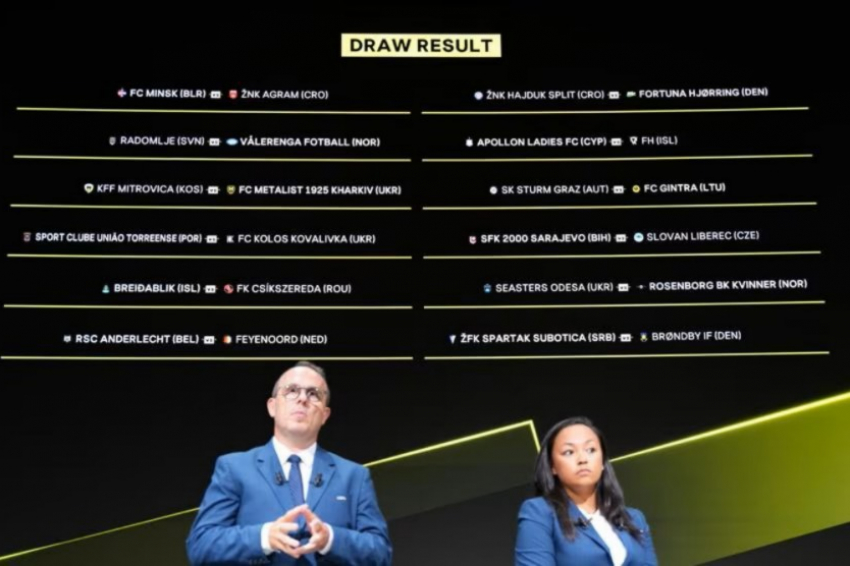
Based on their UEFA coefficients, the field was divided into 12 seeded and 12 unseeded teams, before two draw groups were formed. FK were placed in the second group as an unseeded team, meaning that, in addition to Breiðablik, we could have faced RSC Anderlecht, SFK 2000 Sarajevo, ŽFK Spartak Subotica, Rosenborg BK Kvinner or Sport Clube União Torreense.
At Tuesday’s draw in Nyon, Icelandic champions Breiðablik were ultimately paired with FK Csíkszereda. As the Icelandic side were drawn first, they will host the opening leg on 26 August, with the return fixture taking place in Miercurea Ciuc on 2 September. The exact kick-off times will be confirmed at a later date.
Our club was represented at the draw by Roland Barabási, the women’s team administrator and assistant coach.
“It is a wonderful feeling to be here, and I am proud that we have come this far. It is only at UEFA headquarters that you truly feel you are in one of the centres of European football, at the very highest level of the sport. The surroundings are very pleasant, everything is of the highest standard, and you can sense that everything here revolves around football. Naturally, we will prepare for our Icelandic opponents with great humility. We know that any team which has reached this stage has put in an enormous amount of work, so we are certainly not expecting an easy match. We respect our opponents, but we also believe in ourselves. Our aim is to implement our own game as effectively as possible and give everything on the pitch,” said Roland Barabási.
Head coach Péter Kollár believes that Icelandic women’s football’s European achievements and our opponents’ considerable international experience mean that a demanding tie awaits our team.
“Icelandic women’s football holds a prominent place in Europe. Their national team have qualified for five consecutive European Championships and regularly compete for a place at the World Cup, while their clubs are constant participants in international competitions. I believe we will play two good matches. Our team naturally have little international experience, but we would like to cause an upset. We are preparing accordingly and working towards that goal every single day,” said Péter Kollár. In 2025, Iceland’s national team appeared at the European Championship for the fifth consecutive time.
Our opponents arrive from the Women’s Champions League
Kópavogur-based Breiðablik won both the Icelandic league and cup in 2025, claiming the league title for the twentieth time in their history and completing the domestic double for the ninth time. As a result, they began their 2026–2027 European campaign in the champions path of the UEFA Women’s Champions League.
In the second qualifying round mini-tournament in Kazakhstan, the Icelandic side first faced hosts Aktobe. The score remained 1–1 after both regulation time and extra time, but Aktobe won the penalty shootout 2–0. Breiðablik therefore contested the third-place match against Belarusian side Dinamo-BSUPC. Regulation time ended 2–2 before the Icelandic team scored the winner in extra time, securing a 3–2 victory and a place in the first qualifying round of the Women’s Europa Cup. Under the UEFA competition system, the teams finishing third in the mini-tournaments continue their European campaigns in this round.
Considerable European experience
Breiðablik are one of the most successful clubs in Icelandic women’s football. In addition to their 20 league titles, they have lifted the Icelandic Cup on 14 occasions. They also possess extensive experience on the European stage. They reached the quarter-finals of the UEFA Women’s Cup in the 2006–2007 season and, in 2021–2022, became the first Icelandic club to compete in the group stage of a European competition.
Breiðablik also reached the last eight in last season’s inaugural Women’s Europa Cup. After transferring from the Women’s Champions League, they first eliminated Spartak Subotica 5–1 on aggregate before knocking out Fortuna Hjørring in a memorable tie. Following a 1–0 home defeat, they fell three goals behind on aggregate in Denmark, but eventually fought back to win 4–2 after extra time and advance 4–3 on aggregate. They were stopped in the quarter-finals by eventual winners Häcken of Sweden. According to UEFA’s review, the Icelandic side produced one of the greatest comebacks of the previous campaign.
FK Csíkszereda earned the first senior European qualification in the club’s history by finishing as runners-up in the Romanian Women’s Superliga. The aggregate winners of the tie will advance to the second qualifying round of the Women’s Europa Cup, with the draw scheduled for 4 September.